

As a Chief Revenue Officer (CRO) in a globalized world, you likely oversee teams from different cultures. You’ve mastered product-market fit and sales funnels, but have you considered the impact of cultural fit? Looking back, I realize that cultural differences are the hidden source of many of the management difficulties encountered by CROs operating internationally.
A Tale of Two (or Three) Cultures
Understanding the cultural landscape is essential when managing teams in France, the U.S., and the U.K. Let’s dive into some case studies to see why.
Case Study 1: The Software Upgrade
- The American Perspective: John, the American CRO, hears his French team say they “would consider the upgrade” and assumes it’s a green light.
- The French Perspective: The French team sees their response as tentative, awaiting further discussion.
- Expectations and Frustrations: John is frustrated when no action is taken. The French team feels pressured and overlooked.
Case Study 2: A Leadership Dilemma
- The British Perspective: Emily gives her French team vague yet polite directives.
- The French Perspective: Used to a more hierarchical structure, the French team becomes confused.
- Expectations and Frustrations: Emily is disappointed when tasks stagnate. The French team feels directionless and becomes frustrated.
Decision Making and Trust
Case Study 3: Vendor Selection
- The American Perspective: Sarah, the U.S. CRO, values a vendor’s history and rapport.
- The French Perspective: The French team places more value on the status and credentials of the vendor.
- Expectations and Frustrations: Sarah finds the French team’s hesitance annoying. The French team finds her quick decision-making rash.
Case Study 4: Meeting Etiquette
- The British Perspective: Meetings in the U.K. often start with light conversation.
- The French Perspective: The French prefer to get straight to the point, viewing small talk as a waste of time.
- Expectations and Frustrations: British CROs might see the French approach as abrupt, while the French find the British to be unnecessarily verbose.
Strategies for Overcoming Intercultural Barriers
Understand the Importance of Context
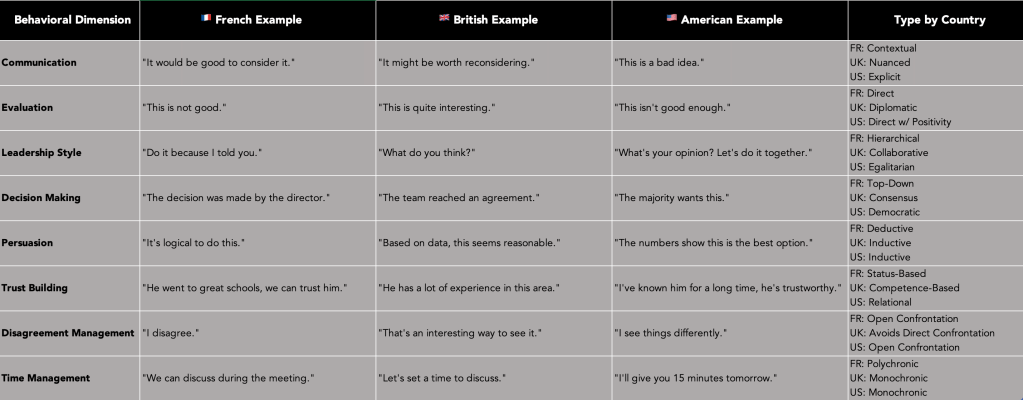
For French employees, understanding context is crucial. Unlike their American counterparts who prefer things spelled out, French professionals often rely on nuance.
Be Explicit Where Necessary
While it’s important to be aware of subtleties, there are times when being explicit is more productive, especially when dealing with American or British team members.
Find a Middle Ground in Leadership
Recognize that while the U.S. and U.K. may favor a more egalitarian approach, the French respect hierarchy. Aim for a balanced leadership style that accommodates both perspectives.
Build Trust Through Different Avenues
While Americans may place trust through personal relationships and the British through competence, the French often gauge trust through status and credentials. Be aware of these tendencies when dealing with team members from different backgrounds.
Examples
Conclusion and Recommendations
Cultural intelligence is not merely an add-on but an essential business skill for a global CRO. By learning to adapt your management style to the cultural norms of your international teams, you can reduce friction and improve performance across the board.
Acknowledgments
The frameworks and concepts in this article are inspired by the work of Erin Meyer, particularly her book “The Culture Map.” Meyer’s work has been instrumental in creating awareness around the importance of understanding cultural dimensions in business.
 Go-To-Market Europe
Leave a comment