

Introduction
In the fiercely competitive landscape of software vendors, the choice of a sales methodology can make or break a business. Throughout my career, I’ve had the opportunity to work with a variety of sales techniques, prompting me to question their respective merits. Too often, businesses select a methodology based on the latest trends or the Chief Revenue Officer (CRO) preferences rather than through rigorous analysis of the business’s needs. That’s why I’ve compiled a detailed comparison of the seven most popular sales methodologies.
Comparison Table of Sales Methodologies
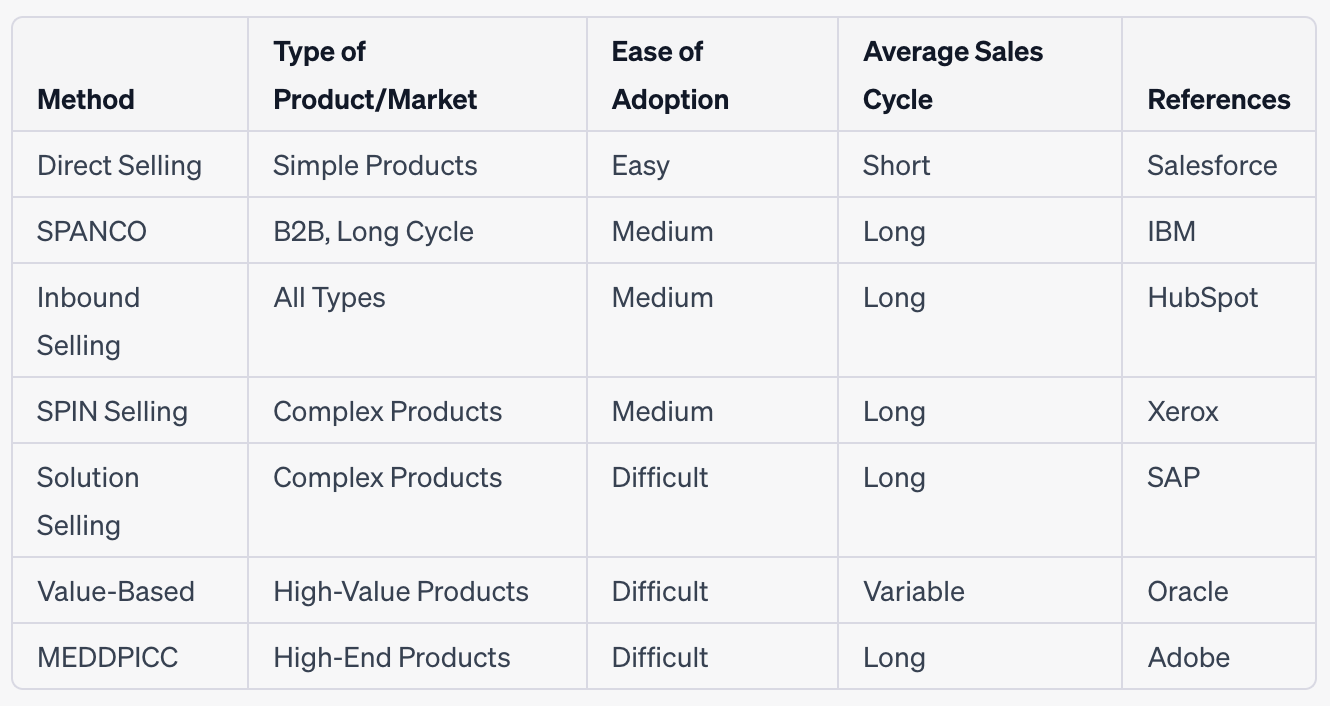
Analysis of Sales Methodologies
Direct Selling
Direct Selling is ideal for less complex products that do not require a lengthy customer consideration period. This method allows salespeople to focus on the close, making the sales cycle generally short.
SPANCO
The acronym SPANCO stands for the different stages of the sales cycle: Suspect, Prospect, Approach, Negotiate, Close, and Order. This method requires the salesperson to follow a strict, hierarchical process, making it particularly useful for long, complex sales cycles.
Inbound Selling
Inbound Selling focuses on attracting customers through the creation of relevant content. The method is in sync with the digital age and is particularly effective when customers conduct online research before purchasing.
SPIN Selling
SPIN is an acronym for the four questions salespeople should ask: Situation, Problem, Implication, and need payoff. This method is particularly suitable for consultative sales, where a deep understanding of the customer’s problem is crucial for offering the most appropriate solution.
Solution Selling
Solution Selling requires a deep understanding of customer needs to offer a tailor-made solution. This approach is particularly effective for complex products or services where understanding customer needs is critical.
Value-Based Selling
Value-Based Selling focuses on the value that the product or service will bring to the customer rather than the price or features of the product. Salespeople need to be highly skilled and capable of effectively communicating this value.
MEDDPICC
A high-precision sales methodology, MEDDPICC focuses on various aspects of sales opportunity qualification, including Metrics, Economic Buyer, Decision Criteria, Decision Process, Identify Pain, Champion, and Competition.
Case Study: Why Did Salesforce Shift from Value-Based Selling to Direct Selling?
Salesforce, known for being a pioneer in SaaS (Software as a Service) sales, has long utilized Value-Based Selling to showcase the added value of its complex solutions. However, as it expanded its offerings and introduced simpler, more affordable products, Salesforce pivoted to Direct Selling. This shift allowed the company to reach a broader audience and expedite the sales cycle while maintaining high levels of customer service.
Conclusion
Each sales methodology has its pros and cons, and their effectiveness can vary depending on the specific needs of your business. Therefore, the choice of methodology should be carefully considered and ideally result from a consultation with a qualified professional. Ultimately, the methodology you choose should be compatible with your products and your sales team, target market, and sales cycle.
I strongly recommend consulting a professional to evaluate the specific needs of your business and select the most suitable sales methodology.
 Go-To-Market Europe
Leave a comment